
Prologue: The Land of Origins
This is the land where humanity took its first steps. Where kings carved churches from mountains. Where the earth burns with primordial fire. And where tribes have kept their traditions alive for millennia.
Over fourteen days, walk where Lucy walked—3.2 million years ago. Stand before churches carved by angels. Descend into the hottest place on Earth, where sulfur lakes paint the desert in impossible colors.
Break bread with Omo Valley tribes. Roast coffee over charcoal fires. Dance to rhythms that have echoed across these valleys for generations.
Your plane drops through the clouds over a city built on a sea of eucalyptus trees. That’s Addis. The highest capital in Africa. And from the moment you step off the plane, you’ll smell it: roasting coffee. This is where it all began, after all.
Your guide (who will quickly feel like an old friend) meets you with a warm “Selam.” After you settle in at the comfy Hotel, we don’t waste a minute.
First stop? The National Museum, where you come face-to-face with Lucy—or as Ethiopians call her, Dinkinesh, meaning “you are wonderful.” She’s 3.2 million years old and somehow smaller, more ancient, and more powerful than you ever imagined. Then, we’ll wander through the former palace of Emperor Haile Selassie to see the Ethnological Museum—your perfect first taste of the country’s 80+ cultures.
After lunch, get ready for Merkato. It’s not just Africa’s largest market; it’s a beautiful chaos of spice pyramids, colorful textiles, and kids yelling “You! You! Welcome!” Let yourself get lost. That’s the point. We’ll end the day by driving up Mount Entoto, where Addis was born. From the top, as the sun sets and the city sparkles below, you’ll understand why Emperor Menelik II chose this spot.
An early flight north, into the cool, sharp light of the Lasta Mountains. Lalibela feels ancient before you even see the churches.
And then you see them. Carved down into red rock, not built up. Your guide will tell you the legend: King Lalibela had a divine vision to build a New Jerusalem, and at night, angels worked alongside the men.
You’ll start at Bete Medhane Alem—the largest rock-hewn church on the entire planet. Inside, the incense is thick, priests in white chant prayers that haven’t changed in 800 years, and you’ll feel the weight of a million pilgrims who’ve stood exactly where you’re standing. You’ll walk through dark trenches connecting churches, run your hand along stones worn smooth by centuries of faithful hands. By the time you reach Bete Golgotha (the sacred resting place of King Lalibela himself), you won’t be a tourist. You’ll be a pilgrim.
Wake up early. At 7 am, we’re hiking up to Mount Asheten Mariam. This isn’t a forced march—it’s a slow, beautiful walk through eucalyptus forests, past farmers plowing with oxen. You’ll visit a quiet monastery, drink coffee in a farmer’s hut, and watch village life unfold without a single souvenir hawker in sight.
Back down for the main event: Bete Giyorgis, the Church of St. George. It’s carved in the shape of a perfect cross, sunk 40 feet into a trench. Descend the narrow path. Stand before it. This isn’t just the symbol of Ethiopia—it’s a masterpiece that will bring a tear to your eye, I swear. We’ll finish with the Eastern Group of churches, including the impossibly elegant Bete Amanuel, which might have been the king’s private chapel.
A relaxed morning in Lalibela, then a flight back to Addis. Check back into Bentark Addis, rest that hotel bed, and charge your cameras. Tomorrow, we go to hell. (Literally.)
This is the day your friends won’t believe. You fly east to Semera, and when you step off the plane, the heat hugs you. Not gently. This is the hottest place on Earth.
We hop in a 4x4 and drive across lava fields to Lake Afdera. And here’s the fun part: your guide will say, “Want to swim in a salt lake so dense you can’t sink?” And you’ll say yes. And you’ll float like a cork, grinning like an idiot.
Then, Lake Asale (Karum) —a blinding white salt flat stretching to the horizon. As the sun gets low, camels appear out of the shimmering heat, carrying salt blocks the same way they have for centuries. We set up chairs, crack open a cold drink, and watch the flats turn gold, then pink, then deep orange. You’ll camp under stars so bright you’ll swear you can hear them.
Rise before the sun. Dallol is 116 meters below sea level, and it looks like a rainbow threw up on a sulfurous hellscape. Green, yellow, red, blue—hot springs bubble, steam hisses, and the air smells like matches. You are absolutely not on Earth anymore.
After lunch, we drive toward Erta Ale, one of the only volcanoes on earth with a permanent lava lake. You’ll trek across volcanic rock for about three hours as the sun sets. And then… you see the glow on the horizon. A red-orange pulse, like a heartbeat. You climb the final ridge, and there it is—a churning, boiling lake of molten rock 100 meters wide. The heat hits your face. The ground hums. You’ll sit on the crater rim, watching the planet’s core, and sleep right there, the lava’s glow keeping you warm.
One last look at the lava lake in the morning light (less infernal, still incredible), then the long drive back. One final, floating swim at Lake Afdera. Then a flight to Addis, where a hot shower and a real bed will feel like the greatest luxury on earth.

You fly south to Jinka, and the air changes—warmer, heavier, full of stories. You’ll check into your Lodge and spend the afternoon at the Jinka Museum, learning about the Mursi, Hamar, Karo, and other tribes you’re about to meet. It’s essential context. Go to bed with your head full of images.

Today, you drive into Mago National Park to meet the Mursi people. The women wear lip plates—clay disks inserted into their lower lips as a mark of adulthood and beauty. Your guide will handle the photography fees respectfully, but more importantly, he’ll help you connect beyond the camera. You’ll share smiles, gestures, and genuine curiosity.
Then, Turmi and a Hamar village. The women wear copper jewelry and ochre-styled hair. Kids run up to practice their English. And if you’re lucky (we always plan for lucky), you’ll hear the drums. A bull jumping ceremony. You’ll watch young women ask to be whipped in support of the initiate. You’ll see a young boy run naked across the backs of a line of cattle—four times without falling. And when he doesn’t fall, the crowd erupts. He is a man now. You have witnessed something ancient and sacred. You will never forget it.
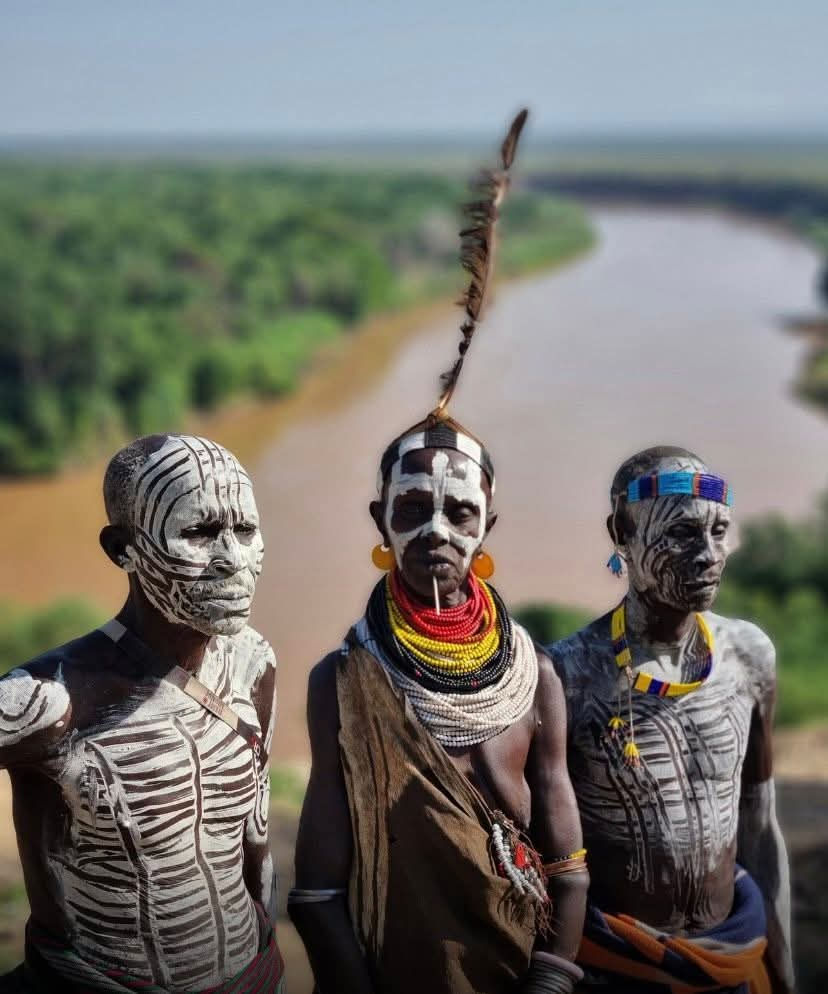
Drive to Korcho, a village perched on a cliff above the Omo River. The Karo people are masters of body painting—intricate patterns in white, yellow, red, and black. Each design tells a story. They’ll paint you, too, if you ask. From the cliff, you look down at the river winding through the savanna. Then you visit the Nyangatom, semi-nomadic warriors and honey collectors. Back to Buska Lodge with your mind full of faces.
Cross the Omo River by traditional boat to meet the Dassanech—"People of the Delta." They fish, farm the floodplains, and wear colorful beads and hollow calabashes on their shaved heads. Then, drive north to Konso, a UNESCO World Heritage site of stone-walled terraces that have been farmed for centuries. You’ll walk through a fortified village, enter through low gates meant to slow invaders, and see Waga—wooden ancestor statues standing in silent, powerful rows.

Drive to Arba Minch ("Forty Springs") and check into your Lodge. And here’s the secret: do nothing this afternoon. Sit on your verandah, order a beer, and watch the sun set over Lakes Abaya and Chamo. Watch the mountains turn gold, then purple, then deep blue. Breathe. You’ve earned this.

Drive up into the highlands to meet the Dorze people. Their houses are 10-meter-tall beehives made of bamboo and enset leaves. You’ll go inside one, watch weavers at work, and then—the highlight—you’ll be invited into a a welcome Schnapps ceremony. You won’t be a guest. You’ll be family.
In the afternoon, take a boat onto Lake Chamo. Crocodiles the size of logs bask on sandbanks. Hippos surface nearby, blinking lazily. Fish eagles cry overhead. It’s pure, wild Africa.
Fly back to Addis. You’re different now. You’ve walked through fire, climbed mountains, broken bread with tribes. You’ve seen the cradle of humanity.
Tonight, we go to Yod Abyssinia, a traditional restaurant. You’ll eat injera with your hands, spicy doro wat, and sip tej (honey wine) from a beaker. Musicians play ancient instruments. Dancers in white robes spin and leap. And by the end of the night, you’ll be on your feet, dancing clumsily and joyfully with people who started as your guides but have become your friends.
Your driver waits. It’s time for the airport. As you drive through the lights of Addis, you’ll realize something: this isn’t goodbye. Ethiopia leaves footprints on the soul. And you’ll carry these footsteps with you, always.

From 2.600 Euro
(inkl. Inland Flights)
Group:
1 to 12 Guests


